ICDAR 2026  ·  Oral Presentation

REPLICA

An Agentic Framework for Visually Faithful Document Reconstruction

1 BharatGen  ·  2 IIIT Hyderabad
* Equal Contribution
Reconstruction — pick a method to compare against the input
Input Document
Reconstruction Output
Fidelity Radar — REPLICA vs. baselines
Green ✓ = axis preserved. TE Text Extraction · LS Logical Structure · PS Physical Structure · VF Visual Fidelity.
Overview

Abstract

PDFs preserve layout, typography, and visual styling — but that fidelity vanishes when converted to the web. Existing tools recover text and structure yet discard physical layout, color, and positioning. REPLICA reconstructs documents into web-native HTML that preserves BOTH semantics AND visual appearance.

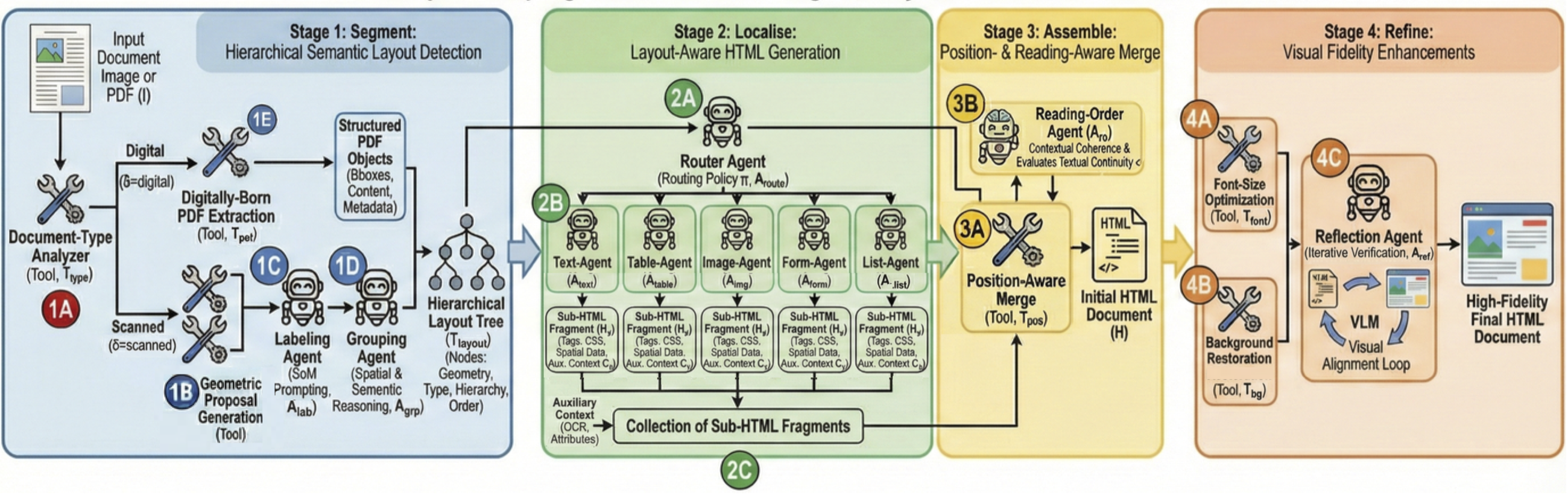
While PDF remains the standard for digital documents, it integrates poorly with web-native environments. Existing document-to-HTML systems prioritize text accuracy and logical structure while discarding physical structure — typography, color, and precise spatial organization. REPLICA is an agentic document-to-HTML framework that generates visually faithful, layout-aware, semantically enriched HTML we call FID-HTML. It uses a four-stage pipeline — Segment, Localize, Assemble, Refine — and generalizes across diverse document types and multiple languages. For evaluation we introduce VFDR-Bench, spanning 22 languages and 17 domains with high-fidelity FID-HTML annotations. REPLICA achieves 93% visual fidelity, outperforming strong baselines including GPT-5 and Gemini-2.5-Pro. Notably, REPLICA with Qwen3-VL-8B achieves a 39% overall gain over Qwen3-VL-30B despite being 3.75× smaller at comparable inference time — showing structured agentic design beats brute-force scale.

What's New

Three Core Contributions

Representation

FID-HTML

A high-fidelity, semantically enriched HTML representation that encodes six complementary dimensions of a document.

FID-HTML is a high-fidelity, semantically enriched HTML representation that jointly preserves content, structure, geometry, and visual styling. Unlike generic HTML which merely permits visual fidelity, FID-HTML guarantees it by encoding six complementary dimensions. It serves as both the canonical ground-truth format for VFDR-Bench and the target output of REPLICA, enabling downstream tasks like layout-preserving translation, grounded document intelligence, and semantic chunking for RAG.

Original document

"Facts of Life" — scanned magazine fact sheet (input page).

fid-html · "Facts of Life" (ground truth)

This is the real Fid-HTML source of the page on the left. Click a dimension to spotlight exactly where it lives in the code — flip to Rendered to see this exact markup drawn by your browser (the text is real and selectable).

FID-HTML vs. Other Formats full · P partial · × missing

T.E. Text Extraction · L.S. Logical Structure · P.S. Physical Structure · V.F. Visual Fidelity  ·  R.O. = Reading Order, L.H. = Layout Hierarchy.

Benchmark

VFDR-Bench & Metrics

A Visually-Faithful Document Reconstruction benchmark with high-fidelity FID-HTML annotations.

Hugging Face View VFDR-Bench on Hugging Face
Benchmark Comparison — TE / LS / PS / VF coverage
VFDR-Bench is the only document benchmark that evaluates both Physical Structure (PS) and Visual Fidelity (VF).
How It Works

The REPLICA Pipeline

A four-stage agentic pipeline transforms a document page into visually faithful FID-HTML.

Figure 4 — Full pipeline overview. Segment partitions the page into hierarchical semantic regions · Localize routes each region to specialist agents that emit sub-HTML fragments · Assemble orders and merges fragments into a globally consistent DOM · Refine optimizes fonts, restores backgrounds, and iteratively verifies with a reflection agent.
Design Philosophy
Interactive

Pipeline Demo

Pick a document, then step or play through REPLICA's four stages. Intermediate outputs are pre-computed — no live inference.

 Input document
1

Segment

Hierarchical semantic layout detection
Fig. 4 · pipeline map
REPLICA pipeline overview (Figure 4)
Sub-HTML output
Stage 1 · 0
Speed
Use Step to advance one beat, or Play for the cinematic auto-walkthrough. The left map follows the story — drag/scroll it to explore (📷 re-enables auto-follow). Keyboard (while hovering): space = play/pause, ←/→ = step, R = restart, F = fit map.
Evaluation

Quantitative Results

On VFDR-Bench — 5,000 documents across 22 languages and 17 domains.

Metric Comparison — switch metric, bars sorted high→low, REPLICA highlighted
Main Comparison — Table 2

NTED↓ is lower-is-better; all other columns are higher-is-better. Best value per column in accent.

Ablation — Table 3, cumulative components
Cumulative Overall Score (OS↑)
Agent & Tool Reliability — Table 4
Results

Qualitative Comparisons

Original document (left) vs. REPLICA's reconstruction (right). The right panel is the actual FID-HTML rendered live — try selecting the text: it's real, not an image.

Original
REPLICA Reconstruction live FID-HTML · selectable
1 / 1
Applications

Downstream Applications

FID-HTML unlocks layout-aware document intelligence. Hover an application to zoom into it — click to pin.

REPLICA downstream applications overview
Cite

BibTeX

Raghuveer_2027_REPLICA