An Agentic Framework for Visually Faithful Document Reconstruction
PDFs preserve layout, typography, and visual styling — but that fidelity vanishes when converted to the web. Existing tools recover text and structure yet discard physical layout, color, and positioning. REPLICA reconstructs documents into web-native HTML that preserves BOTH semantics AND visual appearance.
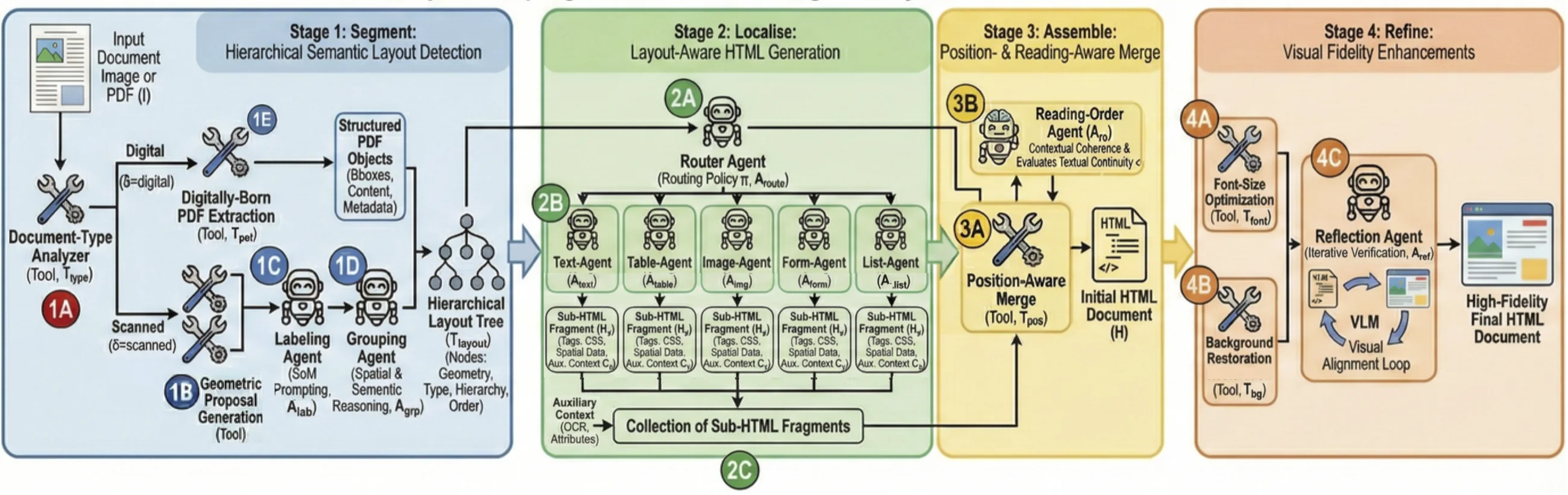
While PDF remains the standard for digital documents, it integrates poorly with web-native environments. Existing document-to-HTML systems prioritize text accuracy and logical structure while discarding physical structure — typography, color, and precise spatial organization. REPLICA is an agentic document-to-HTML framework that generates visually faithful, layout-aware, semantically enriched HTML we call FID-HTML. It uses a four-stage pipeline — Segment, Localize, Assemble, Refine — and generalizes across diverse document types and multiple languages. For evaluation we introduce VFDR-Bench, spanning 22 languages and 17 domains with high-fidelity FID-HTML annotations. REPLICA achieves 93% visual fidelity, outperforming strong baselines including GPT-5 and Gemini-2.5-Pro. Notably, REPLICA with Qwen3-VL-8B achieves a 39% overall gain over Qwen3-VL-30B despite being 3.75× smaller at comparable inference time — showing structured agentic design beats brute-force scale.
A high-fidelity, semantically enriched HTML representation that encodes six complementary dimensions of a document.
FID-HTML is a high-fidelity, semantically enriched HTML representation that jointly preserves content, structure, geometry, and visual styling. Unlike generic HTML which merely permits visual fidelity, FID-HTML guarantees it by encoding six complementary dimensions. It serves as both the canonical ground-truth format for VFDR-Bench and the target output of REPLICA, enabling downstream tasks like layout-preserving translation, grounded document intelligence, and semantic chunking for RAG.
"Facts of Life" — scanned magazine fact sheet (input page).
This is the real Fid-HTML source of the page on the left. Click a dimension to spotlight exactly where it lives in the code — flip to Rendered to see this exact markup drawn by your browser (the text is real and selectable).
T.E. Text Extraction · L.S. Logical Structure · P.S. Physical Structure · V.F. Visual Fidelity · R.O. = Reading Order, L.H. = Layout Hierarchy.
A Visually-Faithful Document Reconstruction benchmark with high-fidelity FID-HTML annotations.
A four-stage agentic pipeline transforms a document page into visually faithful FID-HTML.
Pick a document, then step or play through REPLICA's four stages. Intermediate outputs are pre-computed — no live inference.
On VFDR-Bench — 5,000 documents across 22 languages and 17 domains.
NTED↓ is lower-is-better; all other columns are higher-is-better. Best value per column in accent.
Document parsing tools recover the words. Document reconstruction recovers the page.
Most document parsing and PDF-to-HTML tools convert a scanned or born-digital page into Markdown or generic HTML. They do OCR and document layout analysis well, and they usually recover reading order and logical structure. What they discard is the physical structure — the column grid, the typography, the colour, and the exact position of every block on the page. Open the output beside the original and it is recognisably a different document.
REPLICA performs HTML reconstruction rather than parsing: it rebuilds the page as web-native FID-HTML that preserves content, structure, geometry and visual styling together. The table below is the direct comparison on VFDR-Bench, from Table 2 of the paper.
| System | Type | CRR↑ | NTED↓ | LPS↑ | GPS↑ | VFS↑ | Overall↑ |
|---|---|---|---|---|---|---|---|
| Marker | Pipeline parser | 0.82 | 0.61 | 0.19 | 0.34 | 0.74 | 0.53 |
| Docling | Pipeline parser | 0.49 | 0.62 | 0.17 | 0.26 | 0.55 | 0.38 |
| Qwen3-VL | Vision-language model | 0.79 | 0.59 | 0.22 | 0.30 | 0.43 | 0.47 |
| Gemini-2.5-Pro | Vision-language model | 0.42 | 0.56 | 0.14 | 0.31 | 0.82 | 0.47 |
| GPT-5 | Vision-language model | 0.79 | 0.49 | 0.21 | 0.43 | 0.86 | 0.58 |
| REPLICA (ours) | Agentic reconstruction | 0.93 | 0.20 | 0.73 | 0.86 | 0.93 | 0.86 |
NTED↓ is lower-is-better; all other columns are higher-is-better. LPS and GPS measure local and global physical structure; VFS measures visual fidelity. Full 16-method table in the paper.
Marker and Docling are strong at OCR and text extraction — Marker reaches 0.82 character recall. But local physical structure collapses to 0.19 and 0.17. The text survives; the page does not.
GPT-5 and Gemini-2.5-Pro produce pages that look plausible (0.86 and 0.82 visual fidelity) yet place blocks poorly — global position peaks at 0.43. They redraw the page rather than reconstruct it.
REPLICA reaches 0.73 local and 0.86 global position — roughly 3× and 2× the best baseline — while leading on text, logical structure and visual fidelity simultaneously.
Can I convert a PDF to HTML and keep the layout? That is exactly the problem REPLICA targets. Generic PDF-to-HTML conversion preserves text and some logical structure; REPLICA additionally preserves absolute and relative positioning, font size, colour, text attributes, figures and background.
How is this different from document parsing? Parsing extracts content out of a document. Reconstruction rebuilds the document as HTML, so the rendered output is visually comparable to the input page. We measure that difference explicitly with GPS, LPS and VFS.
Does it handle scanned documents and multiple languages? Yes. VFDR-Bench covers single- and multi-column, scanned and born-digital pages, across many languages and document categories, with expert human-annotated ground truth.
Original document (left) vs. REPLICA's reconstruction (right). The right panel is the actual FID-HTML rendered live — try selecting the text: it's real, not an image.
FID-HTML unlocks layout-aware document intelligence. Hover an application to zoom into it — click to pin.